





















The Korean translation of garment making is “clothes building,” noted one of Ashlynn Park’s colleagues. It was an apt observation given that with her spring collection, the designer—who studied architecture prior to taking up fashion—is steadily constructing a way of working and building a business that no huffing or puffing could disarrange. This is thanks to Park’s strong foundation: patternmaking. To emphasize that this skill is the defining aspect of the brand, pattern pieces were printed on the floor of the Cristina Grajales Gallery and on the scarves left on each seat.
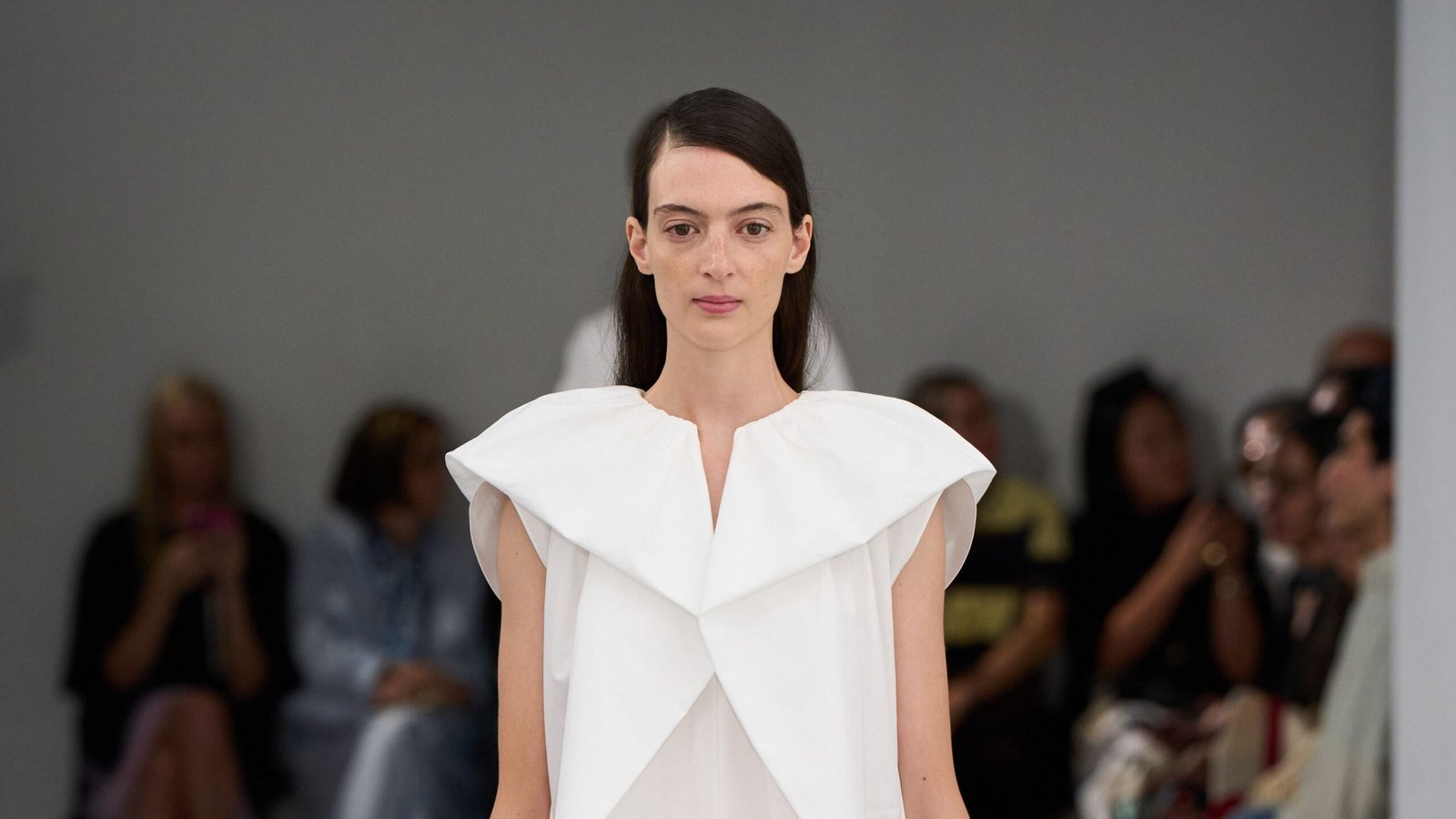
Spring’s basic building block was the square. Park’s creativity is sparked by limitations, in this case four-edged pieces of cloth, which she made sing in several distinct ways. When gravity has its way with a square, it falls in beautiful drapes, which a model demonstrated at one point by lifting up the edges of her skirt’s handkerchief peplum to reveal its flat geometry.
Park further developed her puzzle construction method, employing it to build a puff-sleeve cropped jacket that had an upside-down U shape at the center back, and also to create ruffly rococo-style volume on other garments. The designer reprised fall’s unraveled fringe, but a bolder texture was created by sewing innumerable squares—12 yards’ worth—in rows across a backing fabric. These were astonishing but a bit bulky and actually heavy; a lighter variation on the method was used on a red short-sleeve A-line shirt that peeked out from under a black fringed vest, creating a Rothko-esque kind of visual bleed effect.
“If you want to find newness, then you need to twist first, reposition, replace,” noted Park. Some of the collection’s asymmetric pieces in the collection demonstrated this very clearly, like the white cotton polo shirt that had a partly open back. A button-down had a skewed collar, and skort hybrids were also in the mix.
As the team worked on the collection, Park said, “I felt we were building something that without the wearer, without the body, didn’t stand.” She is a designer who generally does center a woman’s body. This was done most sensuously when edges of squares were pulled so tightly together that the fabric ruched. She should consider developing the idea further. The visible tension in the piece had an energy that benefited this inventive, orderly, and, as always, beautifully executed collection.