










Every actor dreams of a role that changes everything.
For international actress Despina Mirou, that moment may have arrived with Scarface Resurrection, a bold new film inspired by one of the most influential movies in cinematic history. In a performance that is already generating industry buzz, Mirou accomplishes something few actors would even attempt: she portrays herself while simultaneously bringing to life both Tony Montana and Elvira Hancock, the iconic characters made famous by Al Pacino and Michelle Pfeiffer.

It’s a creative gamble that demands courage, discipline, and extraordinary versatility.
For Mirou, it became an opportunity to prove just how far she was willing to go in pursuit of her craft.

Filmed throughout New York City, Scarface Resurrection reunites figures connected to the legacy of the original film while introducing a fresh, contemporary perspective. The production features Roberta Pacino, sister of Al Pacino; original Scarface star Steven Bauer; the late Ángel Salazar in one of his final screen appearances; media personality Michael Musto; and a diverse cast of performers from the worlds of film, comedy, and entertainment.

Yet among the impressive ensemble, Mirou’s performance has emerged as one of the production’s most intriguing storylines.
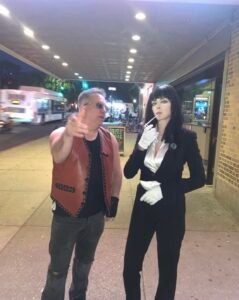
To portray Elvira Hancock, Mirou underwent a significant physical transformation, losing nearly twenty pounds to recreate the sophisticated elegance associated with Michelle Pfeiffer’s legendary portrayal. To become Tony Montana, she embraced an entirely different energy—studying the character’s commanding presence, explosive confidence, and unmistakable swagger.
The transformations were not only physical.

Mirou personally handled much of her own makeup work, carefully crafting the visual details necessary to disappear into each character.
“It took me about seven minutes to become Michelle and around forty minutes to become Tony,” she recalls.
What might be most surprising, however, is what happened once filming ended each day.

While many performers would welcome rest after a demanding shoot, Mirou continued performing throughout New York’s nightlife scene. Appearing at renowned venues including Broadway Comedy Club, New York Comedy Club, Phoenix Bar & Grill, and The Producers Club, she entertained live audiences while remaining fully immersed in character.
One evening she would appear as Tony Montana, commanding the room with fearless confidence. Another night she would become Elvira Hancock, channeling the glamour and mystery that made the character unforgettable.
The performances quickly became a local sensation.

Word spread throughout New York’s comedy and entertainment circles about the actress who seemed capable of becoming entirely different people before an audience’s eyes. Patrons arrived expecting stand-up comedy and left talking about a transformation they had never seen before.
Director Eric Spade Rivas recognized Mirou’s commitment early in production and encouraged her to improvise freely. That creative freedom allowed her to contribute not only as an actress but as a collaborator, helping shape scenes and moments throughout the film.

Photographer Rob Klein captured many of the most remarkable stages of her journey, documenting a series of images that showcase the dramatic contrast between the characters. In one frame she appears as the glamorous Elvira. In another she is almost unrecognizable as Tony Montana. Together, the photographs reveal the extraordinary range required to inhabit both roles convincingly.
What makes Mirou’s achievement particularly noteworthy is that her performances never rely on imitation alone. Rather than offering simple impressions of beloved characters, she searches for the humanity beneath them. Her Tony Montana possesses the fire and ambition audiences remember, while her Elvira Hancock reveals a subtle emotional depth that feels both familiar and refreshingly new.

Off screen, Mirou’s determination mirrors the very qualities that have defined her career.
When asked how she managed the relentless pace of filming, rehearsing, transforming, and performing, her answer was simple and direct.
“I’m not in New York on vacation. I’m here to work.”
That work ethic may ultimately become one of the defining stories behind Scarface Resurrection.
As anticipation continues to build around the film, audiences will undoubtedly be eager to see how this unique reimagining of the Scarface legacy unfolds. But one thing is already certain: Despina Mirou has delivered a performance built on ambition, transformation, and fearless commitment.
For an actress constantly searching for new challenges, Scarface Resurrection may well mark the beginning of an exciting new chapter—one that places her firmly in the spotlight and reminds audiences that great performances often come from artists willing to take extraordinary risks.